Exosome vs Hyaluronic Acid: Their Differences and How They May Complement Each Other
Key takeaways:
- Exosome skincare and hyaluronic acid support skin in different ways: hyaluronic acid focuses on hydration, while exosome skincare focuses more on repair, resilience and cellular communication.
- Hyaluronic acid is a well-established hydrator that helps attract and retain moisture, making it especially useful for dry, dehydrated or tight-feeling skin.
- Exosome skincare may be more relevant when the skin is stressed, sensitised or recovering, particularly when barrier repair and overall skin quality are the main priorities.
- Neither ingredient replaces the other. Hyaluronic acid helps improve moisture levels, while exosome skincare may support longer-term recovery and barrier resilience.
- Using both may provide a more complete approach for skin that needs hydration and repair at the same time.
- The better choice depends on your skin condition, treatment history and main concern, whether that is dehydration, sensitivity, ageing, barrier damage or post-procedure recovery.
Introduction
There have been debates between exosomes and hyaluronic acid. One is a decades-old hydration staple with an impressive body of research behind it. The other is newer, more biologically complex, and increasingly appearing in clinical practice.
Understanding exosome vs hyaluronic acid properly, and whether you actually need both, is worth researching properly.
Exosome vs Hyaluronic Acid: At a Glance
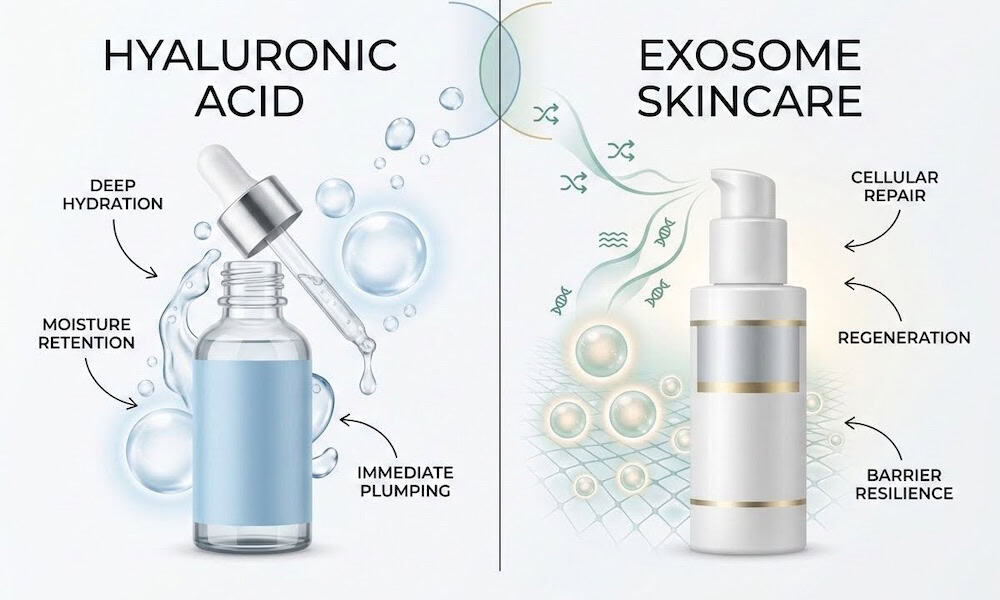
Exosomes vs hyaluronic acid is not a case of one replacing the other. They operate through entirely different mechanisms and address different aspects of skin health. Hyaluronic acid is a hydrator. Exosomes are cellular messengers.
So both have a role, but not the same one.
What Are Exosomes in Skincare?
Exosomes are tiny extracellular vesicles, typically between 30 and 150 nanometres in diameter, that act as messengers between cells. They carry proteins, lipids, and nucleic acids, and their primary job is facilitating intercellular communication involved in repair and regeneration.
Research published in PMC confirms that exosomes in skincare regulate inflammation, matrix remodelling, and pigmentation, and that the benefits extend to barrier resilience, hydration support, and overall skin quality, particularly when the skin has experienced environmental stress or undergone a procedure.
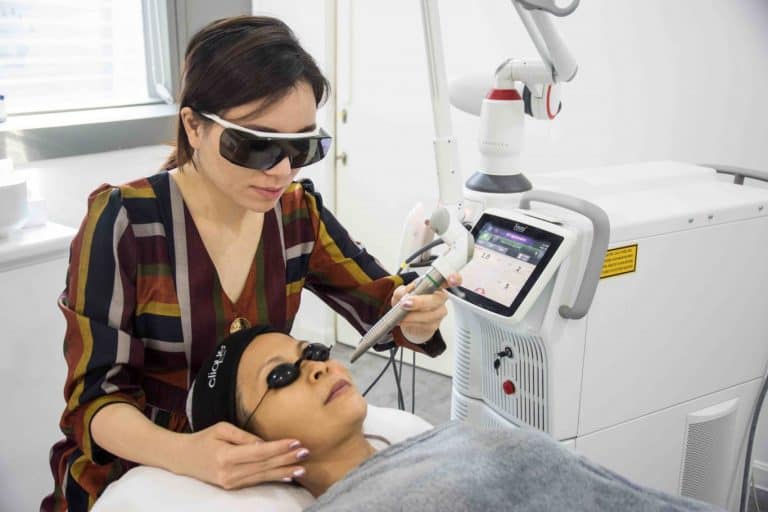
At Clique Clinic, exosome skincare is offered as a professionally recommended addition, especially for clients recovering from treatments such as microneedling, RF microneedling, or laser sessions, when the skin needs meaningful repair support alongside topical hydration.

What Is Hyaluronic Acid?
Hyaluronic acid is a naturally occurring substance found throughout the body, with over half its total concentration residing in the skin. The hyaluronic acid benefits for skin are well documented: it binds up to 1,000 times its volume in water, helping to attract and retain moisture within the skin layers.
A comprehensive review in PMC confirms that hyaluronic acid improves hydration, skin smoothness and plumpness while supporting barrier integrity by reducing transepidermal (skin barrier) water loss. It remains one of the most clinically validated hydrating skincare ingredients available.
Exosome vs Hyaluronic Acid: What’s the Difference?
The exosome vs hyaluronic acid distinction comes down to function. One repairs. One hydrates. Here is how they compare directly:
| Exosome Skincare | Hyaluronic Acid | |
|---|---|---|
| Primary role | Supports repair and regeneration | Provides hydration |
| Main benefit | Skin recovery and resilience | Moisture retention and plumping |
| Skin barrier | Supports barrier recovery | Helps maintain hydration within the barrier |
| Anti-ageing | Supports overall skin quality | Reduces the appearance of dehydration lines |
| Best suited for | Stressed, sensitised, or ageing skin | Dry, dehydrated, or tight-feeling skin |
| Evidence | Emerging, formulation-dependent | Extensive and well established |
Which Ingredient Is Better for Your Skin Concern?
Dry or Dehydrated Skin
If you have dry or dehydrated skin, hyaluronic acid for dry skin products is usually the first clinical recommendation. It delivers immediate, measurable improvements in surface moisture levels.
That said, exosomes for dry skin products may add value when skin dehydration is accompanied by a compromised barrier or chronic sensitivity. When the skin cannot retain water effectively due to an impaired barrier, adding a hydrator offers limited benefit. Repair has to happen first, or simultaneously.
So the best skincare for dehydrated skin addresses both layers of the problem, so combining both may be worth exploring, particularly after a skin consultation.

Skin Barrier Support
Hyaluronic acid for skin barrier health works by reducing transepidermal water loss and maintaining moisture levels within the stratum corneum. It is a cornerstone of barrier maintenance. PMC research confirms hyaluronic acid’s active role in wound healing and barrier function across skin ages and conditions.
Exosomes for skin barrier support operate differently. Rather than sitting on top of the barrier, they may influence the repair processes underneath it. A 2023 PMC review found that exosome-based formulations promoted cell proliferation, collagen production and tissue regeneration in compromised skin.
Individuals with a chronically weakened barrier may benefit from both approaches working together.
Fine Lines and Ageing Skin
Hyaluronic acid temporarily plumps dehydration lines by drawing water into the skin. The effect is visible and well established. At Clique Clinic, hyaluronic acid is also a core component of skin booster treatments, which deliver it directly into the dermis for longer-lasting hydration results.
Exosome skincare approaches ageing differently. Rather than plumping, it focuses on longer-term skin quality: supporting resilience, regulating signalling pathways involved in collagen synthesis, and addressing the repair deficit that comes with intrinsic ageing.

Sensitive or Stressed Skin
Hyaluronic acid is generally well tolerated across skin types, making it a reliable choice for sensitive skin. Exosome skincare may be particularly relevant when the focus is recovery from environmental stress, post-procedure sensitivity, or barrier disruption.
A 2025 split-face clinical study in PubMed found that exosome-treated sides showed greater improvements in texture, hydration, elasticity and pigmentation when exosomes were combined with microneedling or CO2 laser.
At Clique Clinic, this is exactly the context in which exosome skincare can be used, as a repair-focused skincare addition that complements procedures, not as a standalone replacement for hydration.
Hydration vs Repair: Do You Need One or Both?
Hydration and repair are complementary processes, not competing ones. Exosomes and hyaluronic acid together may address a wider range of skin needs than either alone.
Think of it this way. Hyaluronic acid fills the glass. Exosomes help fix the glass so it can hold water properly. For skin that is dehydrated but otherwise healthy, hyaluronic acid alone may be sufficient.
For skin that is stressed, sensitised, post-procedure, or showing signs of chronic barrier impairment, repair-focused skincare, alongside hydration, often yields better outcomes.
Is Hyaluronic Acid Enough for Healthy Skin?
Hyaluronic acid is one of the best hydrating skincare ingredients available, and the evidence on this spans decades of clinical research. But hydration is only one pillar of skin health.
A weakened skin barrier, environmental stress, sensitivity, or recovery after aesthetic procedures all require more than moisture. This is where exosomes for skin barrier repair and broader cellular support may play a complementary role.
Exosomes vs hyaluronic acid is not a competition, and neither replaces the other. Exosomes address what hyaluronic acid alone cannot: the repair, resilience, and cellular communication that underpin lasting skin health.
For many individuals, using both provides a more complete and balanced approach to overall skin quality.
Should You Choose Exosome Skincare, Hyaluronic Acid, or Both?
Choose hyaluronic acid if your main concern is dehydration, tightness or loss of surface plumpness. Consider exosome skincare if your skin feels stressed or sensitised, or if your priority is barrier recovery and long-term resilience.
Many individuals benefit from using both, because they address different needs: hyaluronic acid for hydration, while exosome skincare focuses more on repair. However, product quality matters in both categories. Hyaluronic acid formulas vary by molecular weight and supporting ingredients, while exosome products differ in source, stability and formulation.
Professional guidance helps match the right product or combination to your skin condition, routine and treatment history. In Clique Clinic, our exosome skincare range is designed to complement proven hydrators rather than replace them.
Final Thoughts
Hyaluronic acid and exosome skincare serve different purposes, so they don’t compete directly. Hyaluronic acid excels at hydration and moisture retention. Exosome skincare focuses on supporting repair, resilience and overall skin quality.
Together, they form a well-rounded routine that addresses both immediate hydration and longer-term skin health.
Choosing the right approach depends on your skin concerns, tolerance, and treatment history.
If you are unsure whether your skin needs hydration, repair, or both, our Clique doctors can help you assess your skin needs through a personalised skin consultation. Our exosome skincare range is available exclusively in-clinic and is recommended as part of a personalised approach. Chat with us on WhatsApp to book your session.