
Understanding Melasma: Causes and Risk Factors for Malaysian Skin Types
Key Takeaways:
- Melasma: is a chronic skin condition marked by symmetrical brown or greyish patches, often affecting the cheeks, forehead, upper lip, and chin.
- Sun exposure: hormonal changes, and genetics are the primary causes, with tropical climates like Malaysia increasing the risk due to high UV radiation.
- Darker skin types: common in Malaysia are more susceptible to melasma due to heightened melanocyte sensitivity.
- Effective treatments: include topical agents, chemical peels, laser therapies, and tranexamic acid, often combined for better outcomes.
- Long-term prevention: requires daily sun protection, a gentle skincare routine, and lifestyle adjustments, ideally under a dermatologist’s guidance.
Introduction
Melasma is a distressing cutaneous disorder that visibly affects one’s cheeks, forehead, upper lip, and chin. Characterised by brown or grey-brown patches of hyperpigmentation, melasma isn’t life-threatening. However, it can take a considerable psychological toll on patients.
The chronic disorder is much more prevalent in women and results from the overproduction of melanin by melanocytes. However, the exact mechanisms that stimulate this overactivity remain complex and unknown to many. Additionally, the condition is prone to persistent recurrence, which further complicates treatment efforts.
This blog aims to investigate the causes and risk factors associated with melasma. It also seeks to explore its management and effective multi-modal maintenance treatment interventions. So, without further ado, let’s get started!
What is Melasma?
Melasma is a common chronic pigment disorder that’s defined by dark, brown or grey-brown patches. In practice, this acquired pigmentary disorder results from the overproduction of melanin.
Melasma primarily affects one’s face, particularly the cheeks, forehead, upper lip, chin, and sometimes the nose. While it can affect people of all skin tones, melasma is more prevalent in individuals with darker skin types, like Malaysians.
Furthermore, women are particularly susceptible to the disorder, especially during periods of hormonal change i.e., during pregnancy or hormonal therapy. Generally, melasma isn’t physically harmful, but it can be cosmetically distressing.
Melasma vs other pigmentation issues
Melasma is often confused with other pigmentation conditions, such as freckles and post-inflammatory hyperpigmentation (PIH). However, it’s defined by distinct features that set it apart. Understanding these distinctions is imperative for accurate diagnosis and management.
Melasma vs Hyperpigmentation
Melasma is a unique type of hyperpigmentation. However, the two terms aren’t interchangeable.
Hyperpigmentation is a broad term that encompasses any condition in which skin patches become darker than the surrounding area due to increased melanin production.
Melasma, however, is distinguished by characteristically larger, symmetrical patches, most often on the face. Furthermore, it’s primarily triggered by hormonal fluctuations.
Also read: Melasma vs Hyperpigmentation: Understanding the Difference and Treatment Approaches
Melasma vs Freckles
Although both freckles and melasma appear as darker dots on the skin, their appearance, causes, and distributions are very different.
Freckles are typically small, flat, and scattered spots that are light brown in colour. They are mostly caused by heredity and exposure to the sun. Furthermore, they are most prevalent among children and adults with fair skin.
Melasma, on the other hand, manifests as larger, more confluent, typically symmetrical, brown or grey-brown patches. They predominantly cover facial areas such as the chin, forehead, cheeks, and upper lip.
While freckles aren’t hormonally driven, melasma is more closely associated with hormonal changes.
Melasma vs Post-Inflammatory Hyperpigmentation
Although both melasma and post-inflammatory hyperpigmentation (PIH) result in dark patches on the skin, their causes and manifestations differ.
PIH appears as distinct, irregular dark patches caused by skin injury or inflammation, such as acne, eczema, or trauma. These spots may occur anywhere on the body, not just the face. Furthermore, they are not typically symmetrical.
Melasma, on the other hand, presents as larger, more diffuse, and often symmetrical patches. These patches are primarily on sun-exposed facial areas. Unlike PIH, melasma isn’t caused by direct injury or inflammation. Rather, it’s associated with hormonal factors and sun exposure.
Causes of Melasma

The main causes of melasma can be summarised as:
- Sun exposure: Ultraviolet (UV) radiation is the main trigger of melasma. Melanocytes, the skin cells that create melanin, are stimulated by UV light and overproduce pigment as a defence mechanism. This consequently results in melasma’s distinctive dark patches.
- Hormonal changes: Melasma is strongly linked to hormonal fluctuations. Pregnancy, birth control and hormone therapy are characterised by hormonal fluctuations that significantly increase melasma risk by influencing melanocyte activity.
- Genetics: Individuals with historical family cases of melasma are more likely to develop the condition. Research suggests that genetic susceptibility and predisposition influence how the skin responds to triggers, such as UV exposure and hormonal changes.
- Other factors: Additional triggers that may exacerbate melasma include stress, certain medications, and some skincare products that increase photosensitivity. These factors may promote inflammation or disrupt the skin barrier, further stimulating melanogenesis.
Risk factors for Melasma in Malaysian skin types
Melasma is notably prevalent and persistent among Malaysians because of a combination of environmental, genetic, and cultural factors, namely:
- Tropical climate: Malaysia is located near the equator. This results in intense and consistent sun exposure throughout the year. High levels of ultraviolet (UV) radiation significantly stimulate melanocytes, leading to increased melanin production. Thereby, triggering or exacerbating melasma.
- Darker skin types: Many Malaysians have Fitzpatrick skin types IV to VI. These skin types natively contain higher melanin levels. As such, they are paradoxically more prone to melasma because their melanocytes are more sensitive to triggers like consistent sun exposure and hormonal fluctuations.
- Cultural and environmental factors: Traditional Malaysian skincare practices and products may not be specifically formulated for melasma treatment. Some traditional skincare products may irritate the skin or increase photosensitivity. Additionally, few Malaysian religiously utilise high-SPF sunscreens, heightening the risk of melasma recurrence.
How to identify Melasma on the skin?
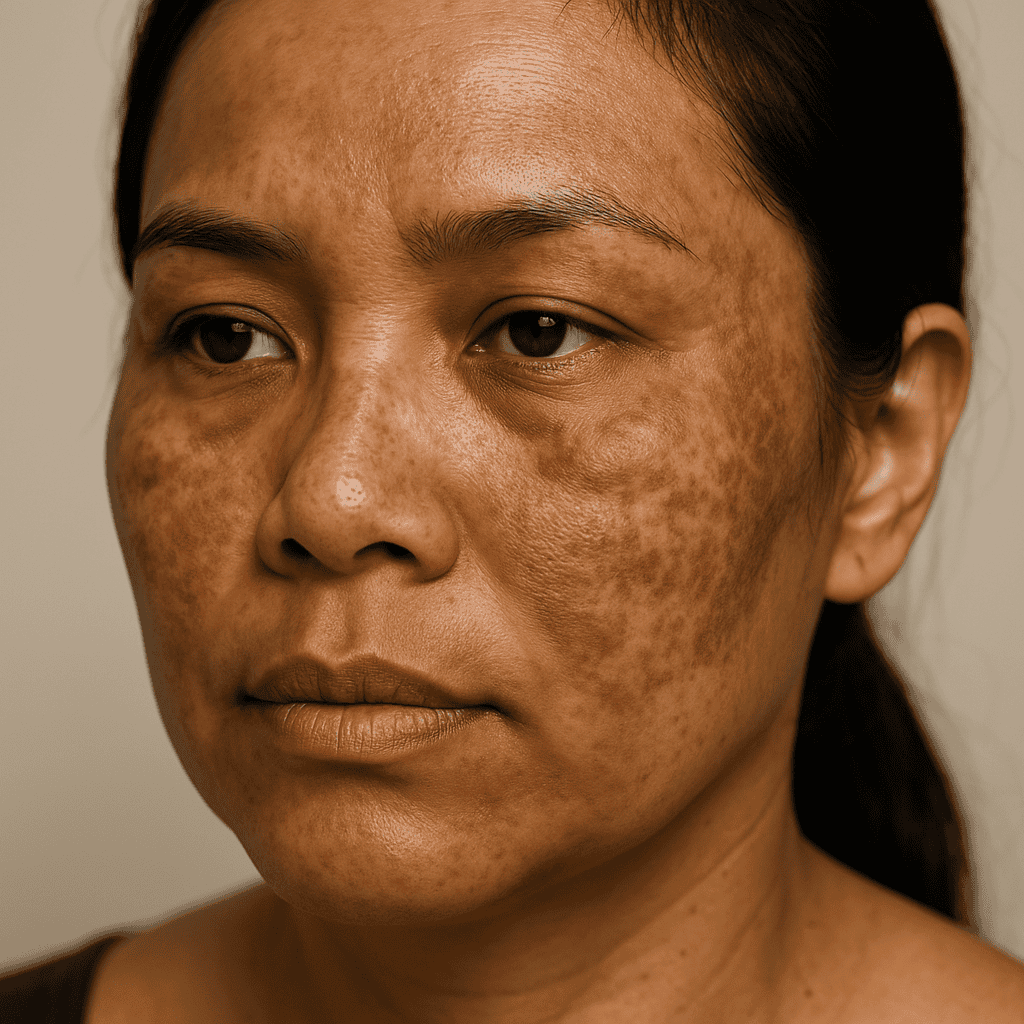
Melasma typically manifests as dark, irregular patches on the skin, usually flat and slightly darker than the person’s natural skin tone. These patches often have well-defined but uneven borders. Furthermore, they can vary in colour from light brown to greyish-brown or bluish-grey.
Additionally, the pigmentation is typically symmetric. This means it appears on both sides of the face in a similar pattern. The most common areas affected by melasma are one’s cheeks, forehead, upper lip, nose, and chin. However, it may sometimes extend to one’s jawline and neck. All these sites are usually sun-exposed (UV radiation is a major trigger).
Best treatments for Melasma
Melasma can be effectively treated through various approaches. However, there is no guaranteed permanent cure due to its complex and multifactorial nature.
Read: The Complete Guide to Melasma Treatment Options in Malaysia
The most effective treatments are:
Topical treatments
Topical creams are the first line of treatment for melasma. The most effective topical products include hydroquinone. This ingredient inhibits melanin production and is often considered the gold standard for lightening dark patches.
Retinoids help accelerate skin cell turnover and promote the shedding of pigmented cells. Vitamin C creams provide antioxidant properties and the ability to brighten the skin by interfering with melanin synthesis. Many treatment regimens combine these ingredients to maximise results.
Chemical peels and laser treatments
Laser treatments and chemical peels are advanced techniques that may be recommended for stubborn cases of melasma.
Chemical peels, especially those that employ glycolic acid (AHA), exfoliate the epidermis to expose more youthful, less pigmented skin beneath. Peels, however, are generally better suited for milder cases of melasma. In fact, they should be used with caution on darker skin types.
Laser treatments are more precise than chemical peels. In laser therapies, high-energy light is employed to target the affected area, removing hyperpigmented skin cells at a deeper level—depending on the severity of the condition.
Additionally, the use of cooling technology, such as with Glacier Rx, promises positive outcomes in the long-term treatment of melasma.
Tranexamic acid
Tranexamic acid (TXA) is an emerging treatment for melasma that possesses the ability to inhibit the interaction between melanocytes and blood vessels, which play a role in melasma’s persistence.
Depending on the intensity and patient compatibility, it can be applied topically, taken orally, or supplied as an injection. Offering a different mechanism of action compared to traditional topical agents, TXA is often used as part of a combination therapy to enhance pigmentation results.
Read: How can I reduce Melasma on my face?
How to treat Melasma naturally?
To naturally treat melasma at home, one can apply aloe vera gel, turmeric paste, lemon juice, and other ingredients such as papaya or sandalwood. These ingredients typically have anti-inflammatory and skin-lightening qualities.
Preventing the progression of melasma also requires regular sun protection and lifestyle modifications to reduce UV exposure. However, expert care and dermatologist consultation are necessary for the safe and effective management of melasma, particularly in severe or persistent cases.
Melasma care and prevention
To prevent melasma recurrences and mitigate its propagation, consider:
- Sun protection: Daily utilisation of a broad-spectrum sunscreen (with SPF 30 to 50 or higher). Wearing wide-brimmed hats and ensuring to always seek shade during peak sun hours also protects sensitive facial areas.
- Consistent skincare routine: Adopt and maintain a gentle skincare regimen that avoids irritating or photosensitising products. This helps prevent melasma flare-ups.
- Diet and lifestyle: Incorporate antioxidants through dieting. For example, consume vitamins C and E, green tea, and foods rich in polyphenols to combat oxidative stress that contributes to pigmentation.
Conclusion
The unpredictable nature of melasma’s progression, along with its tendency to recur, makes it more distressing. As we have seen, multiple factors contribute to its development. For instance, genetic predisposition, hormonal fluctuations, and exposure to ultraviolet (UV) radiation.
Furthermore, melasma is more common in women, especially during pregnancy or when using hormonal therapies. Fortunately, melasma has several proven interventions that can effectively manage and reduce its appearance.
Treatment typically involves a multi-modal strategy. For example, topical agents such as hydroquinone and retinoids, and advanced therapies, including chemical peels or laser treatments. Emerging treatments, such as TXA, offer additional options by targeting the vascular and pigmentary components of melasma.
Since melasma can be a persistent and often recurring pigmentary disorder, a tailored approach guided by a dermatologist can significantly improve outcomes.
Experienced dermatologists can methodically adjust treatment, manage side effects, and set realistic expectations—ultimately enhancing long-term control of this challenging condition.